Things
Dessicant
https://www.amazon.com/dp/B071S914ZP?encoding=UTF8&ref=cm_sw_r_cp_ud_dp_HE70RHCW2PH6R17NV3TP&ref=cm_sw_r_cp_ud_dp_HE70RHCW2PH6R17NV3TP&social_share=cm_sw_r_cp_ud_dp_HE70RHCW2PH6R17NV3TP&th=1
Build UPS
Low-Temperature 12V DC UPS for Cable Modem
A native, low-loss 12V DC Uninterruptible Power Supply (UPS) system designed for unconditioned, ventilated enclosures subject to freeze-thaw cycles (down to sub-freezing winter temperatures) and elevated summer heat.
Design Strategy: Unlike standard AC UPS units—which convert AC wall power to DC for the battery, then invert back to AC, only for the modem's power adapter to step it down to 12V DC again—this design operates on native 12V DC power, eliminating inverter idle draw and conversion losses.
1. System Overview & Strategy
Key Advantages:
- Zero Conversion Loss: Eliminates inverter idle draw, extending backup runtime by 3x–4x compared to AC UPS equivalents.
- 0ms Switchover: Zero-delay battery takeover prevents modem reboots during brownouts or transient drops.
- Freeze Protection: Utilizes a self-heating $\text{LiFePO}_4$ battery whose internal BMS diverts incoming charge current to internal heating pads when temperatures fall below $0^\circ\text{C}$ ($32^\circ\text{F}$).
- Extended Calendar Life via Voltage Tuning: Instead of keeping the battery floating at 100% State of Charge (SOC) at $14.4\text{V}$ (which accelerates calendar aging in warm weather), the charging supply voltage is tuned to $13.2\text{V}$, holding the battery at a comfortable 50%–60% SOC during normal operation while retaining ample backup capacity.
2. Wiring Schematic
                      [120V AC Outlet]
                             │
                             ▼
                 [Adjustable Power Supply]
                 (Set to 13.2V DC / Float)
                             │
                             ├───────────────────────────────┐
                             ▼                               ▼
               [Inline Fuse Holder (10A)]         [DC Barrel Output Cable]
                             │                               │
                             ▼                               ▼
             [12V Self-Heating LiFePO4 Battery]   [Comcast Modem (12V DC)]
3. Recommended Parts List
| Component | Function | Notes / Links |
|---|---|---|
| Heated 12V $\text{LiFePO}_4$ Battery | Energy storage with sub-zero freeze protection | TimeUSB 12V 12Ah Self-Heating or Dakota Lithium 12V 10Ah Heated |
| Adjustable 12V Power Supply | Powers load & floats battery at tuned voltage | Mean Well NDR-75-12 or Mean Well DRC-100A |
| Fuse & Holder | Protection on battery positive terminal | 10A Blade Fuse + Waterproof Inline Holder |
| DC Cable Harness | Connects supply/battery to modem power jack | 18AWG 5.5mm × 2.1mm / 2.5mm DC Barrel Cable |
4. Voltage Tuning & SOC Management
Voltage Tuning Note: Standard drop-in $\text{LiFePO}_4$ BMS units do not support software-defined SOC limits. The output voltage must be calibrated using the power supply's potentiometer before connecting the battery.
Calibration Steps:
- Connect a multimeter across the power supply output terminals before attaching the battery.
- Turn the supply's voltage adjustment potentiometer (
SVR1) until the output reads $13.2\text{V}$. - At $13.2\text{V}$, the $\text{LiFePO}_4$ chemistry naturally rests between 50% and 60% SOC. Current flow stops automatically once battery potential equals charger voltage.
Voltage & SOC Operating Profiles:
| Voltage Setting | Target State of Charge (SOC) | Operating Profile |
|---|---|---|
| $14.4\text{V} - 14.6\text{V}$ | 100% | Full capacity; accelerated calendar aging in high ambient heat |
| $13.4\text{V} - 13.6\text{V}$ | 80% – 90% | High backup capacity; low stress |
| $13.2\text{V}$ | 50% – 60% | Optimal longevity for standby float service (Recommended) |
5. Assembly & Installation Instructions
Step 1: Pre-charge & Voltage Matching
- Fully charge the battery indoors using a standard 12V $\text{LiFePO}_4$ charger.
- Discharge the battery down to $\sim 13.2\text{V}$ using a test load or let it sit idle until settled.
Step 2: Wiring Assembly
- Connect the inline fuse holder directly to the positive ($+$) battery terminal. Do not insert the 10A fuse yet.
- Join the positive output lead of the power supply and the positive conductor of the DC barrel cable to the fused line.
- Connect the negative ($-$) output lead of the power supply, the negative conductor of the DC cable, and the battery negative terminal together.
Step 3: Voltage Verification
- Plug the power supply into wall AC.
- Verify the DC output voltage is set to $13.2\text{V}$.
- Insert the 10A fuse into the inline holder.
Step 4: Final Connection
- Plug the 5.5mm DC barrel connector into the 12V input on the Comcast modem.
- Confirm modem powers on normally. Test grid failure by disconnecting the AC plug; the modem should remain online without rebooting.
6. Cold Weather & Emergency Behavior
Sub-Zero Recovery ($<0^\circ\text{C}$ / $32^\circ\text{F}$): If grid power returns while the enclosure is frozen below $0^\circ\text{C}$, the internal battery BMS automatically diverts incoming charge power to internal heating elements until cells reach safe charging temperature.
- Normal Operation: Wall power supplies $13.2\text{V}$ directly to the modem and keeps the battery sitting at 50%–60% SOC.
- Grid Outage: The battery instantly supplies full 12V power to the modem with zero delay.
- Thermal Protection: Internal BMS prevents cold-temperature lithium plating during sub-freezing conditions.
Build Battery Packs
Cells
-
2025-09-25 diy500amp.com Order #1584
- Ampace JP40 "LT Wrap" 21700 4000mah 70A Battery - Tabless Cell × 120
- Subtotal $474.00 Shipping $22.99 Total $496.99 USD
-
2026-09-09 diy500amp.com Order #3924 Test Chart
- Ampace JP40 "LT Wrap" 21700 4000mah 70A Battery - Tabless Cell × 1 $5.99
- FEB 21700 Battery Cell – 6500mAh 13A Ultra High Capacity Energy Cell × 30 $224.70
- Subtotal $230.69 Shipping $10.80 Total $241.49
Welder
- Heltec HT-SW02H
- Manual
- Order #114-4340207-9060214 2025-10-30
- Spot Welder & Milliohm Meter
- 42 KW 7000A Capacitor Energy Storage Pulse Welding Machine
- Subtotal $729.90 Tax: $43.79 Total: $773.69
Battery Case
- 15 cell m18 kit (8 batteries)
- $389.20
Cost
- Me: $497+$774+$390=$1660
- Milwaukee (with worse cells): $279*8=$2232
Balancer
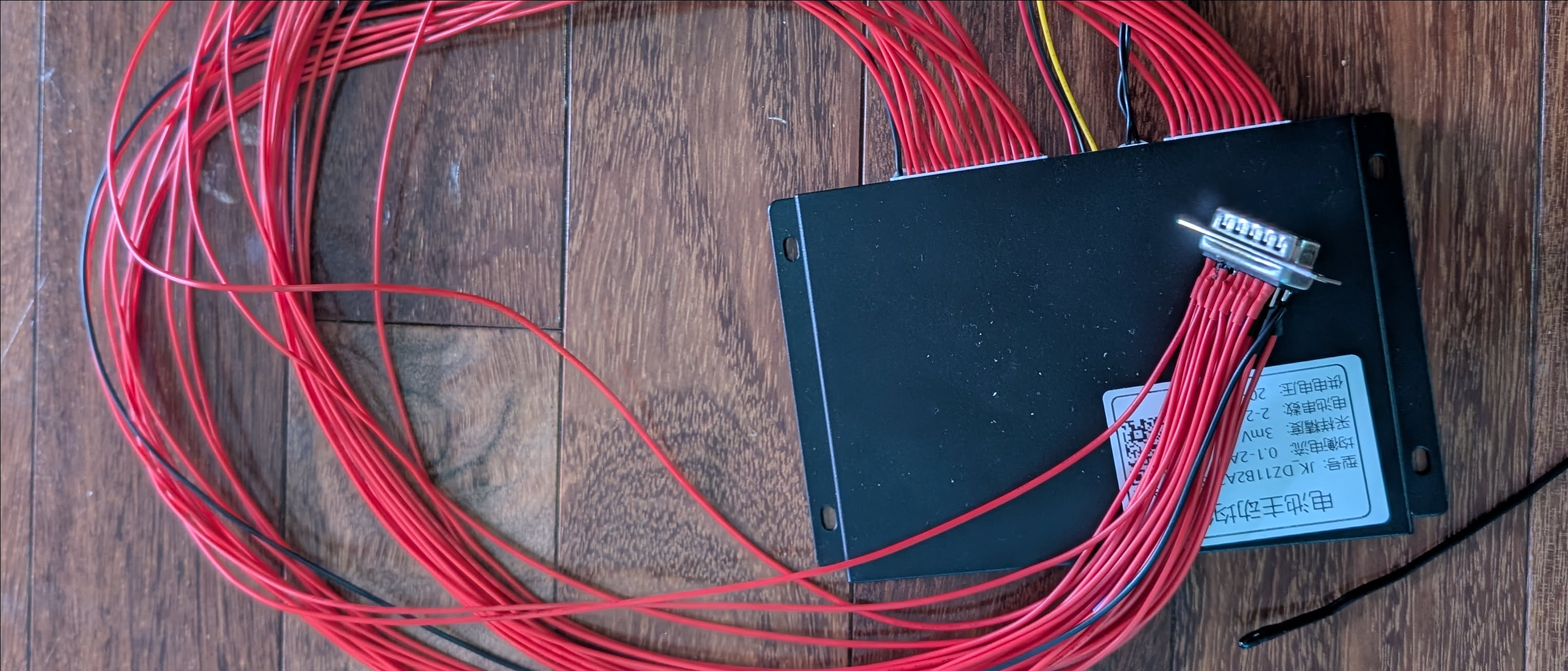
- Balancer: 2A Active Balancer 2S–24S with Built-in Bluetooth RS485 and Temp Sensor for LiFePO4 Li-ion LTO 20V–100V Smart Equalizer Module (JK-DZ11-B2A24S)
- HD26 connectors: shipping
- male CN-DSUBHD26PN-000
- female CN-DSUBHD26SK-000
- 20 wire ribbon 28AWG
- 24x 21700 Sleds
-
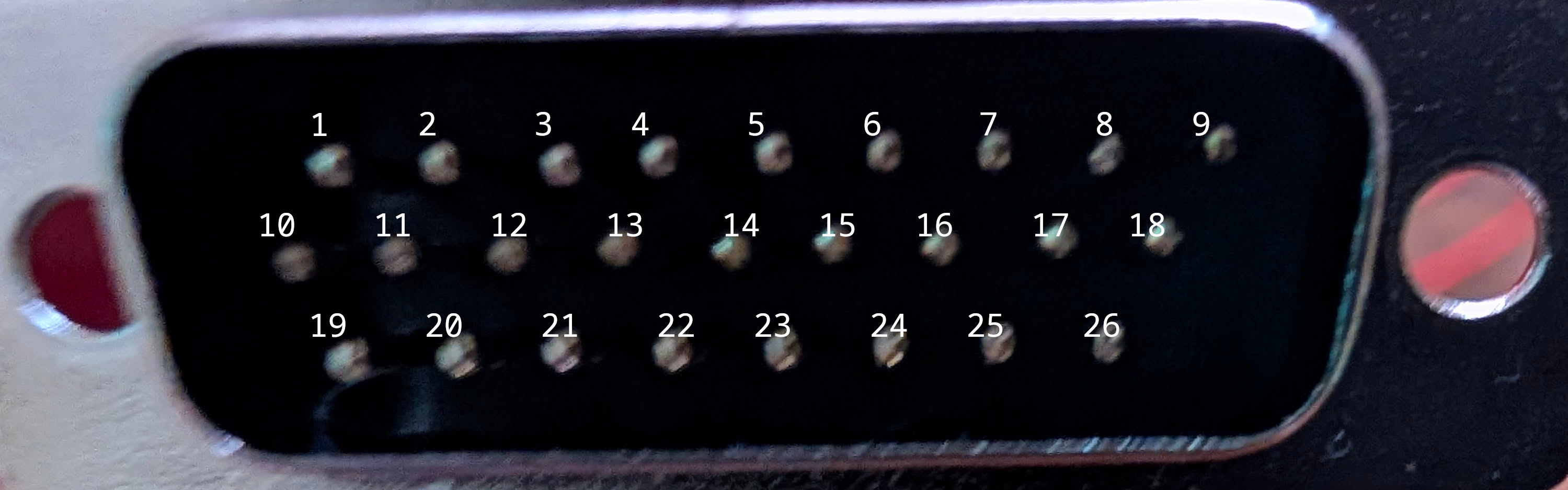
Balancer pinout:

-
1 Cell 18
-
2 Cell 19
-
3 Cell 20
-
4 Cell 21
-
5 No connection
-
6 No connection
-
7 No connection
-
8 Cell 24
-
9 NEGATIVE
-
10 Cell 9
-
11 Cell 10
-
12 Cell 11
-
13 Cell 12
-
14 Cell 13
-
15 Cell 14
-
16 Cell 15
-
17 Cell 16
-
18 Cell 17
-
19 Cell 8
-
20 Cell 7
-
21 Cell 6
-
22 Cell 5
-
23 Cell 4
-
24 Cell 3
-
25 Cell 2
-
26 Cell 1
Assembly
DIY Charger
Cell Information for Packs
| Parameter | Why It Matters | Target Variance |
|---|---|---|
| 1. Discharge Capacity ($\text{mAh}$ / $\text{Wh}$) | Sets the total energy reservoir. The weakest P-group determines when the entire pack's BMS cuts off. | $\le 1\%$ variance across parallel groups |
| 2. Internal Resistance ($m\Omega$) | Governs voltage sag under load and heat generation. In parallel, low-IR cells do more work; in series, high-IR cells heat up faster. | $\le 5\%$ variance across parallel groups |
| 3. Self-Discharge Rate ($\Delta V / \Delta t$) | Cells that bleed voltage while idle will constantly pull down their parallel group, overworking the BMS balance circuits. | Eliminate outliers (reject self-discharge $> 0.01\text{V}$ / week) |
| 4. Voltage Recovery Curve | How fast voltage bounces back after a load is removed. Indicates internal chemical health and degradation. | Reject cells that lag significantly behind the group recovery slope |
| 5. Thermal Delta under Load ($\Delta T$) | Temperature rise during a sustained high-current discharge. | Reject cells that run $> 5^\circ\text{C}$ hotter than the batch average |
Equipment for 21700 Cell Profiling
| Metric / Parameter | Primary Tool Recommendation | Primary Function |
|---|---|---|
| 1. Discharge Capacity ($\text{mAh}$ / $\text{Wh}$) | SkyRC MC3000 $\rightarrow$ BLE Wireless $\rightarrow$ ESP32 Dev Board $\rightarrow$ TTL UART $\rightarrow$ MAX3232 $\rightarrow$ Console Server | Automated C–D–C (Charge-Discharge-Charge) cycling with custom voltage cutoffs ($2.5\text{V}$–$2.8\text{V}$). |
| 2. Internal Resistance ($m\Omega$) | YAOREA YR1035+ $\rightarrow$ TTL to RS232 $\rightarrow$ console server | $1\text{kHz}$ AC 4-wire Kelvin resistance measurement, bypassing contact resistance noise. |
| 3. Self-Discharge ($\Delta V / \Delta t$) | Fluke 87V | High-resolution voltage tracking across a 7- to 14-day resting phase to catch micro-shorts. |
| 4. Voltage Recovery Curve | ZKETECH EBD-A20H $\rightarrow$ GX12-4pin Male Aviation Connector $\rightarrow$ ESP32 $\rightarrow$ TTL to RS232 $\rightarrow$ Console Server | High-rate real-time logging of voltage rebound immediately after removing discharge load. |
| 5. Thermal Delta ($\Delta T$) | K-Type Glass Bead Thermocouple $\rightarrow$ K Type Thermocouple Module $\rightarrow$ MAX31855 $\rightarrow$ ESP32 $\rightarrow$ MAX3232 | Direct surface temperature tracking during high-amp continuous discharge ($10\text{A}$–$20\text{A}$). |
- Device setup
- YAOREA YR1035+
- serial output mod
- Calibration setup:
| Component | Example Part / Model | Source | Est. Cost | Purpose / Function |
|---|---|---|---|---|
| 10mΩ Resistance Standard | Vishay / Dale WSL402610L00FEA or Ohmite FC4L110R010FER (10mΩ, 0.1%, 4-terminal) | DigiKey / Mouser | ~$4.00 | 20mΩ Range Calibration. Low AC inductance metal foil resistor for low-IR cell verification. |
| 100mΩ Resistance Standard | Vishay Y14880R10000B9R or Ohmite FC4L110R100FER (100mΩ, 0.1%, 4-terminal) | DigiKey / Mouser | ~$4.00 | 200mΩ Range Calibration. Calibration standard for higher-IR cells or module assemblies. |
| Breakout PCB / Terminal Board | Custom 4-wire SMD test PCB or generic SOP/SOT adapter board | OSH Park / Amazon | ~$3.00 | Holds the SMT sense resistors cleanly and exposes 4 isolated solder pads for Kelvin clips. |
| DC Voltage Reference Board | AD584LH / AD584KH Precision Voltage Module | eBay / AliExpress / Amazon | ~$15.00 | Voltage Calibration. Outputs 2.500V, 5.000V, 7.500V, and 10.000V with factory DMM calibration slip. |
| 4-Wire Kelvin Test Clips / Leads | High-quality gold-plated Kelvin clips | Amazon / eBay | ~$8.00 | Dedicated test harness to ensure zero contact resistance during calibration passes. |
Safety Equipment and PPE
| Equipment Category | Item | Function & Primary Hazard Mitigation | Essential Specifications |
|---|---|---|---|
| Personal Protection | Full-Face Shield | Face protection from molten nickel spatter during spot welding and high-current arc flashes. | ANSI Z87.1 rated, worn over safety glasses |
| Class 00 Insulated Gloves | Prevents shock and accidental short circuits across exposed high-voltage series strings. | Rated for 500V AC / 750V DC working voltage | |
| Multi-Gas/P100 Respirator | Respiratory protection against toxic HF (hydrofluoric acid) vapor and organic solvents during cell venting. | Organic Vapor / Acid Gas cartridge combination | |
| Bench Infrastructure | Flame-Retardant Silicone Mat | Heat protection for the workbench during soldering and short-circuit containment. | 500°C temperature rating |
| 1000V VDE Insulated Hand Tools | Prevents accidental cross-terminal shorts when tightening busbars or installing balance wires. | IEC 60900 certified cutters, pliers, and wrenches | |
| Kapton / Polyimide Tape | Electrical insulation across cell shoulders, nickel crossovers, and ungrounded sensor probes. | High dielectric strength, 260°C thermal limit | |
| Thermal Emergency | AVD / Lith-Ex Fire Extinguisher | Direct cooling and thermal insulation to interrupt thermal runaway propagation. | Aqueous Vermiculite Dispersion agent |
| High-Temp Battery Fire Blanket | Containment cover for active thermal events, containing flaming debris and smothering surface fires. | Heavyweight 100% woven high-silica fabric (1000°C+ rating) or 4–6 folded layers of heavy fiberglass | |
| Heavy Aramid / Welding Gauntlets | High-temperature hand protection to manually evacuate a venting/hot cell to an outdoor safe zone. | Split cowhide or Kevlar/Nomex lining | |
| Cell Storage | Vented Steel Ammo Cans | Physical containment for unstable, swollen, or quarantine cells. | Metal construction with rubber lid gasket removed |
Voltage Chart
2026-09-09 diy500amp.com Order #3924
Test #1
- Test Date 2026-09-17
- Ampace INR22/71
- FCS451NJ07Z6 3.540
- FEB
- Manufacturer Model: FEB 21700G
- Max Charge Current: 4.55A
- Max Current Basis: 13A
- Test Results
- 65EFCL1006734 3.514
- 65EFCL1004941 3.514
- 65EFCL1006084 3.516
- 65EFCL1001554 3.517
- 65EFCL1004201 3.514
- 65EFCL1005266 3.516
- 65EFCL1005098 3.514
- 65EFCL1002320 3.513
- 65EFCL1002712 3.514
- 65EFCL1006292 3.512
- 65EFCL1001908 3.512
- 65EFCL1005349 3.515
- 65EFCL1005534 3.516
- 65EFCL1003042 3.515
- 65EFCL1005718 3.517
- 65EFCL6000821 3.511
- 65EFCL1004229 3.513
- 65EFCL1006629 3.515
- 65EFCL1003310 3.513
- 65EFCL1000988 3.513
- 65EFCL1001206 3.516
- 65EFCL6000947 3.489
- 65EFCL6001038 3.511
- 65EFCL1000424 3.514
- 65EFCL6001103 3.512
- 65EFCL1003973 3.511
- 65EFCL1005116 3.517
- 65EFCL1004169 3.515
- 65EFCL1005208 3.514
- 65EFCL6000837 3.510
- Ampace INR22/71